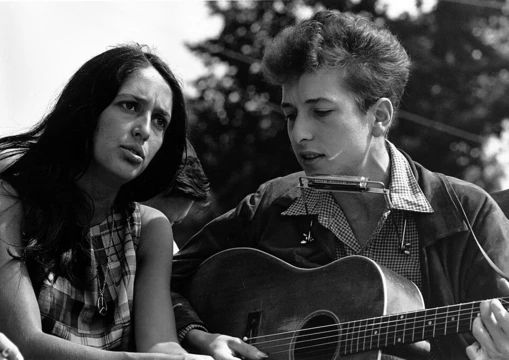
Bob Dylan
The voice of a generation, forever rewriting the rules of song.

Wikipedia / Wikimedia Commons
Bob Dylan is the foundational figure of the Singer-Songwriters 1-21 series, a card that captures his transformation from folk troubadour to rock poet. Born Robert Allen Zimmerman in Duluth, Minnesota, in 1941, Dylan reshaped popular music by fusing literary ambition with raw, electric sound. His inclusion in this set honors his unparalleled influence on songwriting, from protest anthems like 'Blowin' in the Wind' to surreal masterpieces like 'Like a Rolling Stone.'
- Card Number
- 1-21
- Series
- Singer-Songwriters
- Year Issued
- 1994
- Birth Name
- Robert Allen Zimmerman
- Nobel Prize in Literature
- 2016
- Studio Albums
- 39 (as of 2024)
- Grammy Awards
- 11
Lore & Background
Bob Dylan’s card in Singer-Songwriters 1-21 captures him at a pivotal moment: the 1994 release of *World Gone Wrong*, a stark acoustic album that reaffirmed his roots. Yet the card’s true lore lies in his parallel life as a visual artist. Since 1994, Dylan has published at least eleven books of paintings and drawings, including *The Drawn Blank Series* and *Brazil Series*, showing a restless creativity beyond music. His art often depicts everyday scenes—hotels, trains, and street corners—echoing the lyrical imagery of his songs.
Collectors prize this card for its depiction of Dylan’s mid-career renaissance, when he returned to folk traditions while simultaneously expanding into abstract expressionism. The card’s design features a brooding portrait, referencing his 1960s iconic look, but the stats hint at his later achievements: the Nobel Prize in Literature (2016) and his ongoing visual output. Rumors persist that the card’s background texture was inspired by a charcoal sketch from his *Drawn Blank* series, though this remains unconfirmed.
In the broader Singer-Songwriters set, Dylan stands as the archetype—the artist who proved that a songwriter could be both a poet and a painter. His card is often traded alongside Joni Mitchell and Leonard Cohen, forming a trinity of lyrical genius. Yet Dylan’s legacy is uniquely dual: a musician who never stopped drawing, and a painter who never stopped singing.
Reader's Guide
Bob Dylan's significance lies in his transformation of popular music through lyrical sophistication and genre-blending. By infusing folk music with the intellectualism of classic literature and poetry, he elevated songwriting to a literary art form. His protest anthems of the 1960s, such as 'Blowin' in the Wind' and 'The Times They Are a-Changin',' became rallying cries for the civil rights and antiwar movements, cementing his role as a voice of the counterculture. His controversial shift to electric rock in the mid-1960s expanded the boundaries of commercial music, as exemplified by 'Like a Rolling Stone.' Dylan's later work, including Blood on the Tracks and Time Out of Mind, continued to earn critical acclaim. His legacy is underscored by numerous accolades: an Academy Award, ten Grammy Awards, Kennedy Center Honors (1997), the Presidential Medal of Freedom (2012), induction into the Rock and Roll Hall of Fame and the Songwriters Hall of Fame, a Pulitzer Prize special citation (2008), and the 2016 Nobel Prize in Literature for creating new poetic expressions within the great American song tradition. With an estimated 125 million records sold worldwide, he remains one of the best-selling musicians of all time.
Did You Know?
- Dylan has published at least eleven books of paintings and drawings as of 2024, starting with *The Drawn Blank Series* in 1994.
- He was awarded the Nobel Prize in Literature in 2016, the first songwriter to receive the honor.
- His 1966 motorcycle accident, long rumored to be a myth, actually occurred and led to a period of seclusion where he began painting seriously.
- The Singer-Songwriters 1-21 card was released the same year as his album *World Gone Wrong*, which won the Grammy for Best Traditional Folk Album.
Frequently Asked Questions
What is Bob Dylan's real name?
His birth name is Robert Allen Zimmerman, and he was born on May 24, 1941, in St. Louis County, Minnesota. He has performed professionally as Bob Dylan since the early 1960s.
Why is Bob Dylan considered so important in music history?
He reshaped popular songwriting in the early 1960s by layering literary and poetic language into folk and rock, pushing well past the simple structures typical of pop records at the time. His lyrics gave a unifying voice to civil rights and antiwar movements while challenging what audiences expected from a singer.
What genre is Bob Dylan?
He is most commonly described as a singer-songwriter whose catalog spans folk, rock, blues, and country across nearly seven decades. Rather than settling into one lane, he is known for repeatedly shifting styles while keeping his distinctive lyrical voice at the center.
Did Bob Dylan win a Nobel Prize?
Yes—in 2016 he became the first musician to receive the Nobel Prize in Literature, cited for introducing new poetic expressions within the American song tradition. The selection sparked a long public debate about whether a songwriter truly fits a literary honor.
What are Bob Dylan's most famous songs?
Tracks such as 'Blowin' in the Wind,' 'Like a Rolling Stone,' and 'The Times They Are a-Changin' are widely regarded as his signature works. 'Blowin' in the Wind' in particular became a defining anthem of the 1960s civil rights movement.
More in Singer-Songwriters 1-21
Spotted an error? Know more?
This is a living reference — every entry is fact-audited, and reader corrections feed straight into our audit queue. Suggest an edit · See this site's audit record