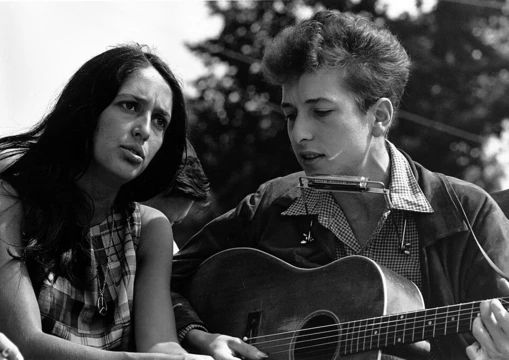
Joni Mitchell
Canadian singer-songwriter known for personal lyrics and genre-blending music.

Wikipedia / Wikimedia Commons
Roberta Joan Mitchell, who was born Roberta Joan Anderson on November 7, 1943, is a Canadian singer-songwriter, multi-instrumentalist, and painter. She rose to prominence from the 1960s folk scene and is widely considered one of the most influential songwriters of her era. Her work is known for deeply personal lyrics and unconventional song structures, and over time she blended folk with pop, jazz, rock, and other styles. Mitchell has won ten competitive Grammy Awards (plus a Lifetime Achievement Award) and was inducted into the Rock and Roll Hall of Fame in 1997. In 2002, Rolling Stone called her “one of the greatest songwriters ever,” and a 2011 AllMusic biography stated that she “may stand as the most important and influential female recording artist of the late 20th century.”
Mitchell got her start singing in small nightclubs in Saskatoon and across western Canada, then moved to Toronto’s club scene. She relocated to the United States and began touring in 1965. Several of her early songs—including “Urge for Going,” “Chelsea Morning,” “Both Sides, Now,” and “The Circle Game”—were first recorded by other artists, which helped her land a contract with Reprise Records. Her debut album, *Song to a Seagull*, came out in 1968. After settling in Southern California, she became a defining voice of her generation with hits like “Big Yellow Taxi” and “Woodstock” (both 1970). Her 1971 album *Blue* is frequently ranked among the greatest albums ever made. Rolling Stone placed it at number 30 on its 2003 list of the “500 Greatest Albums of All Time,” and it rose to number 3 in the 2020 edition. In 2000, *The New York Times* chose *Blue* as one of 25 albums representing “turning points and pinnacles in 20th-century popular music,” and NPR ranked it number one on a 2017 list of the “Greatest Albums Made By Women.”
Mitchell began exploring jazz-influenced sounds on 1974’s *Court and Spark*, which included the radio hits “Help Me” and “Free Man in Paris” and became her best-selling album. Around 1975, her vocal range shifted from mezzo-soprano to a wide-ranging contralto. Her piano and open-tuned guitar work grew more harmonically and rhythmically complex as she blended jazz with rock, R&B, classical music, and non-Western rhythms. Starting in the mid-1970s, she collaborated with jazz musicians such as Jaco Pastorius, Tom Scott, Wayne Shorter, Herbie Hancock, and Pat M
- born
- 7 November 1943
- field
- Singer-songwriter, multi-instrumentalist, painter
- nationality
- Canadian
- known_for
- Personal lyrics, unconventional compositions, influential folk and jazz-influenced albums
Lore & Background
Roberta Joan Anderson was born on November 7, 1943 in Fort Macleod, Alberta to Myrtle Marguerite (née McKee) and William Andrew Anderson. Her mother's ancestors were Scottish and Irish; her father was from a Norwegian family that may have had some Sámi ancestry, according to one family member. However, Norwegian genealogist Arnfrid Mæland disputes this claim, saying that the family tree has no Sámi lineage dating back to the 1600s. She contracted polio at age nine and was hospitalized for weeks. She also started smoking that year, but denies that smoking affected her voice. She moved with her family to Saskatoon, which she considers her hometown, at age 11. Mitchell struggled at school; her main interest was painting. She dropped out of school in grade 12, resuming her studies later. She taught herself guitar from a Pete Seeger songbook; polio had weakened her left hand, so she devised alternative tunings to compensate.
Mitchell began singing in small nightclubs in Saskatoon and throughout western Canada, before moving on to the nightclubs of Toronto. She moved to the United States and began touring in 1965. Some of her original songs ('Urge for Going', 'Chelsea Morning', 'Both Sides, Now', 'The Circle Game') were first recorded by other singers, allowing her to sign with Reprise Records and record her debut album, Song to a Seagull, in 1968. Settling in Southern California, Mitchell helped define an era and a generation with popular songs such as 'Big Yellow Taxi' and 'Woodstock' (both 1970). Her 1971 album Blue is often cited as one of the greatest albums of all time. Mitchell began exploring more jazz-influenced ideas on 1974's Court and Spark, which featured the radio hits 'Help Me' and 'Free Man in Paris' and became her best-selling album. Starting in the mid-1970s, she began working with noted jazz musicians including Jaco Pastorius, Tom Scott, Wayne Shorter, Herbie Hancock, and Pat Metheny as well as Charles Mingus, who asked her to collaborate on his final recordings.
Mitchell produced or co-produced most of her albums and designed most of her own album covers, describing herself as a 'painter derailed by circumstance'. A critic of the music industry, she quit touring and released her 19th and last album of original songs in 2007. The rupture of a brain aneurysm in 2015 led to a long period of recovery and therapy. A series of retrospective compilations were released over this time period, culminating in the Joni Mitchell Archives, a project to publish much of the unreleased material from her long career. She returned to public appearances in 2021, accepting several awards in person, including a Kennedy Center Honor. Mitchell returned to live performance with an unannounced show at the June 2022 Newport Folk Festival and has made several other appearances since, including headlining shows in 2023 and 2024.
Reader's Guide
Joni Mitchell's significance lies in her evolution from a folk singer-songwriter into a genre-defying artist who incorporated pop, jazz, rock, R&B, classical music, and non-Western beats. Her 1971 album Blue is often cited as one of the greatest albums of all time; it was rated the 30th best album ever made in Rolling Stone's 2003 list of the '500 Greatest Albums of All Time', rising to number 3 in the 2020 edition. In 2000, The New York Times chose Blue as one of the 25 albums that represented 'turning points and pinnacles in 20th-century popular music'. NPR ranked Blue number 1 on a 2017 list of the 'Greatest Albums Made By Women'. Her best-selling album, Court and Spark (1974), featured the radio hits 'Help Me' and 'Free Man in Paris'. Mitchell's vocal range shifted from mezzo-soprano to a wide-ranging contralto around 1975. She was awarded the Grammy Lifetime Achievement Award in 2002. Her legacy includes eleven Grammy Awards, induction into the Rock and Roll Hall of Fame in 1997, and recognition by Rolling Stone and AllMusic as one of the greatest songwriters and most important female recording artists of the late 20th century. Her later work included pop and electronic music and political protest, and she produced or co-produced most of her albums and designed most of her own album covers.
Did You Know?
- Mitchell contracted polio at age nine and was hospitalized for weeks; the disease weakened her left hand, leading her to devise alternative guitar tunings.
- Her first paid performance was on October 31, 1962, at a Saskatoon club that featured folk and jazz performers.
- Mitchell's 1971 album Blue was rated the 30th best album ever made in Rolling Stone's 2003 list of the '500 Greatest Albums of All Time', rising to number 3 in the 2020 edition.
- She returned to live performance with an unannounced show at the June 2022 Newport Folk Festival after a long hiatus.
Frequently Asked Questions
Who is Joni Mitchell?
Joni Mitchell, born Roberta Joan Anderson on November 7, 1943, is a Canadian singer-songwriter, multi-instrumentalist, and painter who first gained attention in the 1960s folk scene. She is widely regarded as one of the most influential songwriters of her generation.
What instruments is Joni Mitchell known for playing?
Mitchell is a multi-instrumentalist, most closely identified with her distinctive and unconventional guitar work. She has also incorporated piano and other instruments into her performances and recordings over the years.
How many Grammy Awards has Joni Mitchell won?
Mitchell has collected eleven Grammy Awards throughout her career. She was additionally inducted into the Rock and Roll Hall of Fame in 1997.
What genres does Joni Mitchell blend in her music?
Although she emerged from folk, Mitchell has woven pop, jazz, rock, and other styles into her songwriting across the decades. Her deeply personal lyrics and unconventional song structures make her work resist easy genre categorization.
Why is Joni Mitchell considered so important in music history?
In 2002, Rolling Stone named her one of the greatest songwriters ever, a testament to her lasting influence on the craft. Her willingness to break conventional song structures and write from raw personal experience shaped generations of artists across multiple genres.
More in Singer-Songwriters 1-21
Spotted an error? Know more?
This is a living reference — every entry is fact-audited, and reader corrections feed straight into our audit queue. Suggest an edit · See this site's audit record